
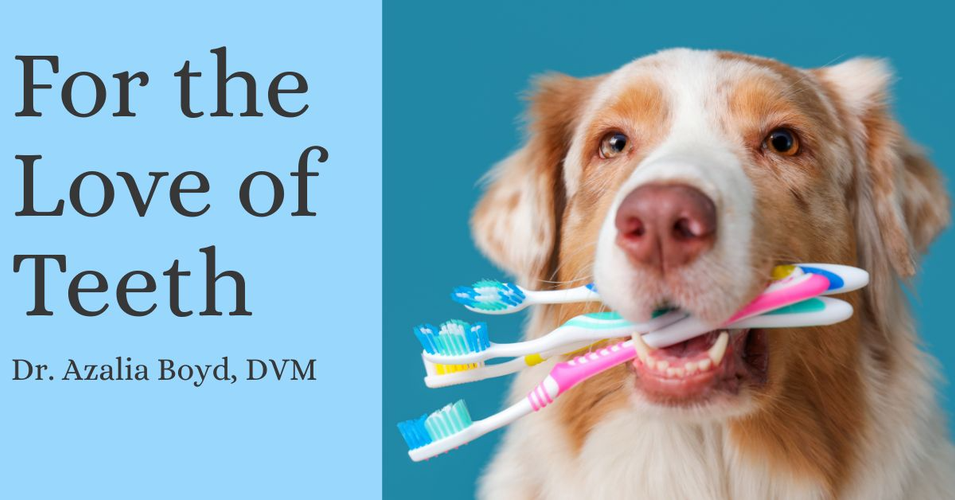
For the Love of Teeth
Posted by Dr. Azalia Boyd, DVM and Natasha Wittmaack, Marketing Content Specialist on 17th Feb 2026
One of the biggest fears people have is going to the dentist themselves. I get it. The scaling. The anticipation of needles. The quiet panic about what might be found based on how much sugar you’ve been eating or how little flossing you’ve done.
Sometimes we project that same fear onto our own furbabies.
But no matter how much we ignore teeth, they will always rear their ugly roots (get it?!) sometimes literally.
The Secret Life of Plaque
Here’s what most people don’t realize.
By age three, over 80 percent of dogs and 70 percent of cats show signs of periodontal disease. It is the most common clinical condition diagnosed in adult pets.
Dental disease begins with plaque. Within 24 to 48 hours, plaque hardens into tartar. Bacteria then move beneath the gumline, causing inflammation, infection, and destruction of the tissues that hold teeth in place.
And it does not stay in the mouth.
When gums are inflamed, bacteria can enter the bloodstream. Research has shown associations between periodontal disease and heart, kidney, and liver changes in pets. What starts as “just bad breath” can contribute to systemic disease.
And here is the humbling part. Pets are incredibly good at hiding pain. They will eat, play, and wag their tails while living with chronic oral discomfort.
Halitosis, or stinky breath, is often the first thing pet parents notice. But by the time breath smells strong, disease is usually already present.
In many cases, your groomer or veterinarian sees the early signs before a pet parent does.
Brush It Like You Mean It
Home care is where we have the most influence.
Brushing remains the gold standard. Even brushing a few times a week significantly reduces plaque buildup. Dental chews approved by the Veterinary Oral Health Council, water additives, dental diets, and oral supplements can all help slow progression. They are not replacements for professional care, but they are valuable tools.
As a veterinarian who admittedly forgets to brush her own dogs’ teeth from time to time (insert melting face emoji here), I say this with love. Do not sleep on dental care.
Listen when your groomer recommends a veterinary visit. They often see redness, tartar buildup, or gum recession long before it becomes severe.
And understand this important point. Non anesthetic dental cleanings cannot clean beneath the gumline. That is where much of the disease lives. Without addressing below the gumline, infection remains in place.
Behind the Scenes of a Professional Cleaning
Fear not. Let me walk you through it.
Your pet is given reassurance and sedation, followed by general anesthesia so they are fully asleep and comfortable. An endotracheal tube is placed to protect the airway, and they are carefully monitored throughout the procedure.
A trained technician performs scaling above and below the gumline and then polishes the teeth to smooth the enamel surface. Each tooth is carefully examined and charted.
Full mouth dental radiographs are often taken because up to 60 percent of dental disease occurs below the gumline, where it cannot be seen during a visual exam alone.
If extractions or additional treatment are needed, your veterinarian calls you to discuss next steps. Transparency and collaboration are key.
Afterward, your pet recovers from anesthesia and is usually brighter within hours, though during recovery I suspect they feel like they’re flying in a galaxy. Many pet parents are usually surprised at how much better their pets seem once painful teeth are addressed.
A Love Letter to Long Term Health

Good, collaborative dental care means pets who live longer, healthier, more comfortable lives.
Dental disease is progressive, but it is also manageable. With teamwork between groomers, veterinarians, and pet parents, we can dramatically improve outcomes.
So do not wait. Have the conversation. Make a plan and protect those smiles.
For the love of teeth, let’s do better for them.
If you have questions or would like to discuss it further, connect with me and the team at Legacy Veterinary Hospital in College Park, Georgia. We’re opening our doors in March 2026 and can’t wait to meet you and your pets.
Healthy mouths matter more than most of us realize.
Yours truly,